Managing Fish Predation Risk in Bivalve Aquaculture
Bivalve farms can manage fish predation more effectively by matching exclusion, deterrence, nursery strategies, and monitoring to the predator, production stage, and local culture system.
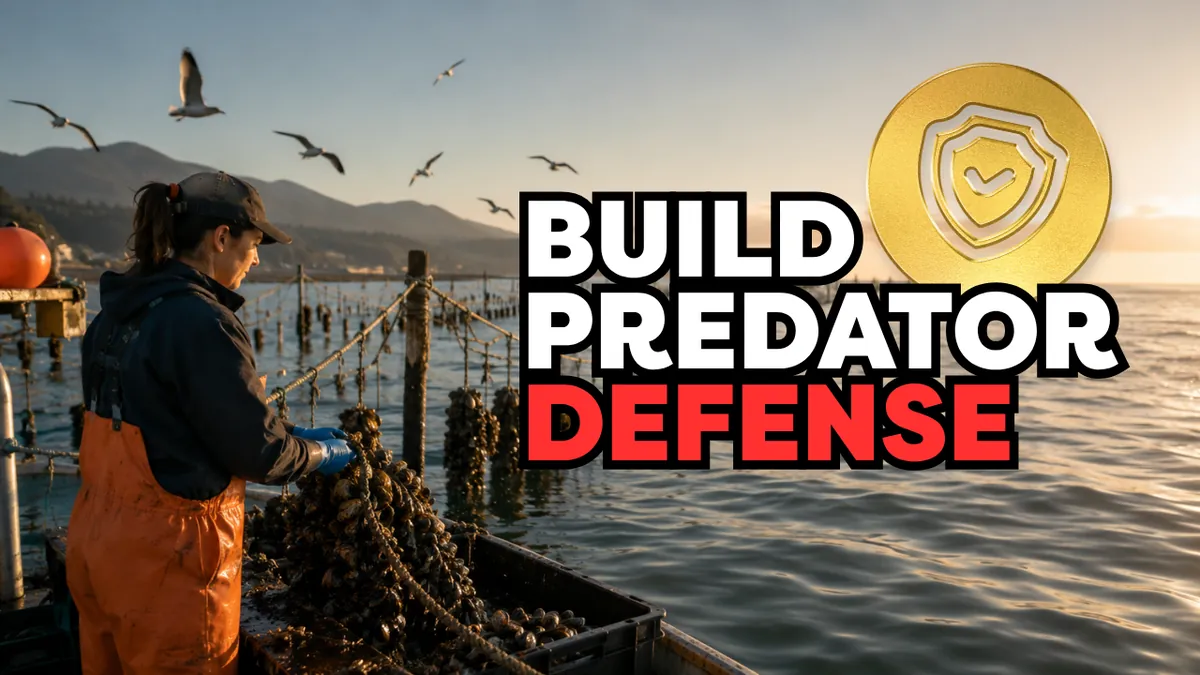
Fish predation can remove a large share of a bivalve crop before losses are fully measured. The risk is not distributed evenly across species, culture systems, or production stages. Suspended infrastructure can aggregate fish by adding three-dimensional habitat to the water column, while seeding and interseeding can expose small, thin-shelled juveniles at the same time that handling releases debris and damaged organisms. Effective control therefore starts with identifying which predators are present, when losses occur, and which part of the production cycle is most vulnerable.
Suspended Culture Can Concentrate Predation Pressure
Suspended bivalve systems introduce ropes, lines, cages, cultivated biomass, and biofouling communities into areas that may previously have offered little vertical structure. These structures can provide refuge and feeding opportunities for fish, increasing the likelihood that opportunistic predators will recruit to or forage within farms. Bottom culture generally creates less structure in the water column and may face a different predator profile, including greater pressure from benthic invertebrates.
This difference matters because infrastructure is not only a passive support for the crop. Its position and complexity can influence local fish distribution and feeding behavior. The effect is especially relevant in uncaged suspended culture, although off-bottom oyster systems and exposed scallop methods may face similar pressure when juveniles remain accessible to fish. Predators may consume cultured bivalves directly or dislodge them incidentally while grazing on biofouling.
Available evidence indicates that predation events can rapidly remove a substantial portion of newly deployed stock under some conditions. The magnitude varies with culture method, predator community, season, site characteristics, and production stage. Predation should therefore be treated as a potentially acute production risk rather than assumed to be only a gradual source of background mortality.
Handling Events Can Create a High-Risk Window
Predation may increase around seeding, thinning, grading, transfer, and other handling events. During these operations, culture structures can be lifted, agitated, or cleaned, releasing biofouling, debris, and damaged organisms. Such material may attract feeding fish. Transport and handling can also coincide with a juvenile stage in which shells, attachment structures, or escape capacity provide limited protection.
Size can influence vulnerability in more than one way. Very small spat may offer too little energetic return to attract intensive feeding, whereas larger juveniles may gain protection as shells strengthen and attachment becomes more robust. The transition between these conditions can create a vulnerable intermediate window. Its boundaries vary with the cultured bivalve, predator feeding morphology, husbandry system, and local environment, so a universal size threshold would be misleading.
The practical implication is not that one shell-length threshold applies everywhere. It is that a farm should map mortality against production activity, animal size, and predator presence. Without this diagnosis, an intervention may be installed across an entire site even though the highest risk is concentrated in a short nursery-to-seeding transition.
Physical Exclusion Works, but Its Cost Changes With Scale
Mesh enclosures and other physical barriers can provide strong protection when they consistently separate predators from the crop. This principle applies across mussel, oyster, clam, and scallop production, particularly where juveniles would otherwise remain exposed. Physical exclusion is already integral to many off-bottom and contained culture systems, but its value depends on barrier integrity, mesh design, water exchange, and maintenance.
The limitation is operational. Nets and cages can increase biofouling, water-flow restriction, handling time, cleaning requirements, and infrastructure costs. These burdens become more difficult to absorb across large suspended grow-out areas. Barriers can also be damaged or displaced by waves and currents, and additional artificial surfaces may promote the settlement or spread of invasive biofouling organisms.
Physical protection may therefore deliver more value when it is concentrated around the most vulnerable production stage. Protecting juveniles in a nursery or early deployment area can reduce the period during which the entire crop depends on costly exclusion infrastructure.
Behavioral Deterrents Need Species-Specific Field Validation
Visual, acoustic, electrical, magnetic, and hydrodynamic deterrents have been used to influence fish behavior in other settings, including industrial water intakes and hydroelectric facilities. Their transfer to bivalve farms is not straightforward. A stimulus that produces an initial avoidance response may lose effectiveness if fish habituate and learn that it has no physical consequence.
Acoustic devices also introduce underwater noise that can extend beyond the target area. Artificial lighting may affect stress, growth, vision, and normal behavior. Bubble curtains combine visual, acoustic, and hydrodynamic cues and avoid some of the fouling problems of solid barriers, but their effects on larval settlement, sediment movement, and non-target species still require evaluation. Electrical and magnetic approaches likewise need testing against the specific fish species responsible for losses.
For these technologies, short trials can overstate operational value. The relevant test is whether the deterrent remains effective over a full production cycle, under site-specific currents and background noise, without unacceptable effects on non-target organisms. Mixed-stimulus systems may reduce habituation, but long-term field evidence remains limited.
Nursery Strategies Shift Protection to the Animal
Holding juveniles in contained nursery systems until they reach a larger, more resistant size may reduce open-water exposure during a vulnerable stage. This approach is already used in oyster and clam production and may also support mussel and scallop systems where early deployment creates concentrated risk. Its effectiveness will depend on whether the additional nursery period produces a meaningful reduction in susceptibility under local predator pressure.
Nursery culture changes the protection strategy. Instead of maintaining barriers around the crop throughout grow-out, the farm invests in controlled early rearing so that stronger shells and attachment capacity become part of the defense after deployment. The trade-off is that nursery capacity, handling, growth performance, and cost must be incorporated into the production model. A larger seed size is useful only when the reduction in predation risk offsets the additional nursery expense and does not create new bottlenecks.
Equipment changes may complement this strategy. More complex dropper surfaces can provide additional attachment sites and physical refuge, while stronger protective stockings may make it harder for fish to access newly seeded mussels. However, the efficacy of these modifications must be measured rather than assumed.
Mitigation Decisions Require More Than Crop Value
A mitigation decision should integrate seed source, shellfish value, production cost, production stage, and sensitivity to predation. The same intervention may be economically justified for high-value hatchery seed at a vulnerable stage but not for low-cost wild seed with limited documented losses. Site exposure, maintenance requirements, ecological effects, and public acceptance also influence feasibility.
Predator removal may improve survival in some situations, but it can be labor-intensive, expensive, difficult to sustain across large areas, and associated with ecological and ethical concerns. Chemical controls can introduce food-safety and non-target risks. These limitations often make prevention, targeted exclusion, husbandry changes, and carefully validated deterrence more practical areas to evaluate first, although the appropriate sequence will remain site-specific.
The central management challenge is matching the intervention to the actual loss mechanism. Monitoring should establish the predator group, timing, affected bivalve size, culture method, and magnitude of loss before capital is committed. That evidence can reveal whether the strongest leverage lies in a nursery stage, a handling procedure, a localized barrier, an equipment change, or a deterrent system. Across mussel, oyster, clam, and scallop production, predation is a variable risk; mitigation is most defensible when it is grounded in the biology of the cultured stock, the behavior of local predators, and the operational realities of the farm.
Listen to Episode 75 of The Aquaculture Podcast Show, “Defending Bivalve Farms From Fish Predation,” for the full discussion.